



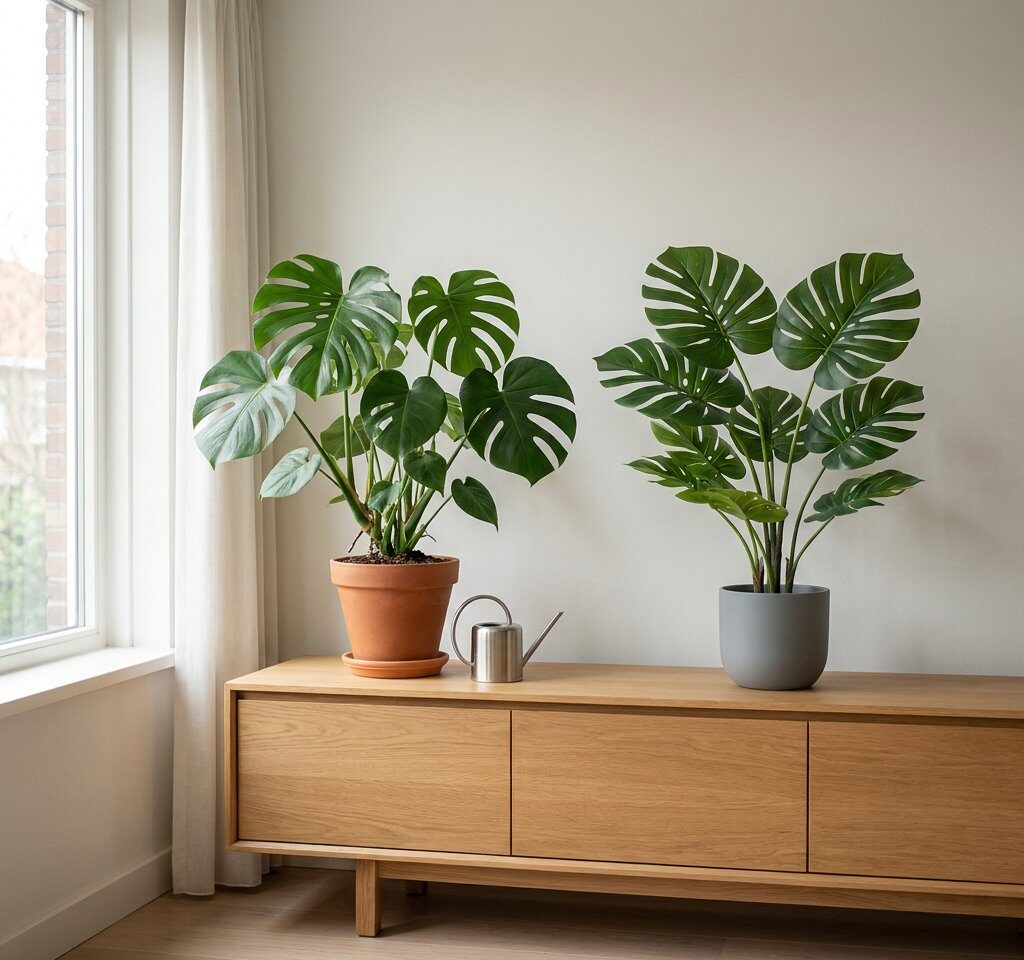
Artificial Plants vs. Real Plants: Which Is Right for You?
|
Are you trying to decide between artificial plants and real plants? Both create a green, inviting space, but differ greatly in terms of care, appearance, and practical applications. A real plant lives, grows, and needs attention. An artificial plant stays beautiful for years without water, sunlight, or a green thumb. Which option is best depends mainly on your interior, the time you have available, and where you want to place your plants.
The main differences at a glance
| Section | Artificial Plants | Real plants |
|---|---|---|
| Maintenance | Dust it off every now and then | Water, nutrition, pruning, and occasionally repotting |
| Daylight | Not necessary | Depending on the plant species |
| Service Life | Long-lasting when used properly indoors | Depending on care and circumstances |
| Appearance | Always green and in good shape | Lively, natural, and ever-changing |
| Air Purification | No air-purifying effect | Limited natural contribution, depending on species and environment |
| Suitable for dark areas | Yes | Often not |
| Long-term price | One-time purchase, few additional costs | Purchase, plus potting soil, fertilizer, and potential replacement |
Maintenance: Artificial Plants Win on Convenience
The biggest difference between artificial plants and real plants is the maintenance. Real plants need water, enough light, and the right temperature. In addition, some species require plant food, a specific potting mix, regular repotting, or protection from drafts and pests. Anyone who is often away, has little natural light, or has no experience caring for plants will quickly realize that a real plant requires attention.
Artificial plants don’t need water, fertilizer, or pruning. All you have to do is remove any dust from the leaves. Read more in the article on caring for artificial plants. In most cases, dusting with a feather duster, soft cloth, or a hair dryer set to the cool setting is sufficient. This makes artificial plants particularly practical for entryways, bathrooms, offices, stores, restaurants, and vacation homes.
Even in places where live plants struggle to thrive, artificial plants offer a solution. Think of a dark corner, a closet without a window nearby, or a room with fluctuating temperatures. An artificial plant stays green and lush there, without needing daylight.
Appearance and Realism: Can Artificial Plants Be Distinguished from Real Ones?
Modern artificial plants are much more realistic than the plastic plants of the past. High-quality varieties, in particular, feature leaf veins, subtle color variations, a matte finish, and flexible stems. Is that how you can tell artificial plants apart from real ones? Up close, that’s often true, but at a normal viewing distance, a high-quality artificial plant is almost indistinguishable from a live plant.
The most lifelike artificial plants are often varieties with sturdy, well-shaped leaves or a recognizable natural growth pattern. Consider an artificial Monstera, Philodendron, Strelitzia, Kentia palm, Areca palm, olive tree, or ficus. Artificial hanging plants and ornamental grasses also quickly create a natural look when placed in a suitable pot or planter.
How can you tell if an artificial plant looks realistic?
- Leaves with variations in color, shape, and vein patterns.
- A matte finish instead of a glossy one.
- Stems that you can gently bend to create a looser shape.
- A natural arrangement of leaves and branches.
- A pot that matches the size and style of the plant.
A good pot makes all the difference. For example, fill the decorative pot with an inner pot, sturdy filler material, and decorative accents such as decorative gravel, moss, or hydro granules. This keeps the plant stable and makes the whole thing look more convincing.
What are the disadvantages of artificial plants?
Artificial plants are low-maintenance, but they aren’t automatically the best choice in every situation. They do not grow along with the plant, do not bloom naturally, and serve no biological function. Those who truly enjoy caring for plants or watching new leaves grow will miss that living quality in an artificial plant.
- Artificial plants do not purify the air the way real plants can, to a limited extent.
- Inexpensive models can look unnatural due to their sheen, uniform leaves, or stiff shape.
- Dust is more noticeable when you don’t clean an artificial plant for a long time.
- Most artificial plants are not suitable for unprotected outdoor use.
- The purchase price of a large, high-quality artificial tree may be higher than that of a small real plant.
If you choose artificial greenery, pay attention to quality and location. An artificial plant can look great on a sheltered porch or under a canopy, but direct sunlight, prolonged rain, and strong winds can cause the material to deteriorate more quickly. Read more in the section on artificial plants and sunlight. Artificial plants are best suited for indoor use.
Comparing Costs: One-Time Investment or Ongoing Maintenance
A fair price comparison between artificial plants and real plants goes beyond just the purchase price. A small, healthy plant is often a good deal, but it can grow into a plant that needs a larger pot, fresh potting soil, and fertilizer. There is also a chance that a plant might not survive due to too much water, too little light, or pests, making it necessary to replace it.
With artificial plants, you usually pay more for a large, realistic model, but there are few ongoing costs. For example, you can buy an artificial palm tree, an artificial ficus, or a Strelitzia in the size you want, and then all you need is a suitable pot and minimal maintenance. That makes artificial plants a good choice for spaces that need to look well-maintained and green over the long term.
Large artificial plants are especially practical when you want to add volume right away. A tall Strelitzia, Kentia palm, or olive tree instantly adds character to an empty corner, near an entrance, or next to a couch. A real plant needs time to reach that size and requires consistent care along the way.
Health, Pets, and Allergies
Live plants can be a nice addition to your home or workplace, but potting soil and damp soil can cause mold to grow if not cared for properly. In addition, some live plant species are not suitable for curious pets or small children. Therefore, always check whether a specific plant is safe for your cat, dog, or household.
Artificial plants do not contain pollen and do not require moist potting soil. That makes them a practical alternative for people who’d rather not have soil in their homes. However, it is important to dust regularly, especially in areas where a lot of dust accumulates. After all, dust on leaves isn’t pleasant for anyone, whether the plant is real or artificial.
Sustainability: Which option is more environmentally friendly?
The most sustainable choice depends on the plant’s entire lifespan and how you use it. Real plants are natural products, but growing them can require water, energy, transportation, and potting soil. Plants that die off quickly or are replaced regularly, in particular, have a greater impact than you might expect.
Artificial plants are made from materials that require raw materials and production. On the other hand, a high-quality artificial plant will last for years. When you use an artificial plant for a long time, restyle it, pass it on, or move it to a different spot, the cost of the purchase is spread out more effectively over a longer period.
Do you want to make a conscious choice? Then don’t keep buying cheap decorations that you’ll replace quickly. It’s better to choose an artificial plant that you really like, that matches your decor, and that will last for years. A timeless plant, such as a ficus, olive tree, palm, or ornamental grass, is easy to rearrange when you redecorate your home. Read more in the section on artificial plants and sustainability.
When is it best to choose real plants?
Real plants are a good fit for you if you have access to natural light, time, and enjoy taking care of them. They create a lively, ever-changing look and can add a personal touch to an interior. Live plants really come into their own, especially in a well-lit living room, sunroom, or workspace with the right conditions.
You should opt for real plants if you:
- enjoy watering, pruning, and repotting;
- there is enough natural light where the plant will be placed;
- enjoys watching a plant grow and change;
- you want to care for a specific plant species on purpose.
When are artificial plants the smart choice?
Artificial plants are ideal if you want to add some greenery without any hassle. They are suitable for busy households, dark areas, and commercial spaces where a neat and tidy appearance is important. They are also a reliable solution for bathrooms, hallways, offices, stores, reception areas, or hospitality interiors.
At Eliassen, you’ll find artificial plants in a variety of sizes, from compact plants and hanging plants to large artificial trees. For example, a 120-cm artificial Monstera looks great next to an armchair, while a tall Strelitzia or Kentia palm instantly fills an empty corner. Combine different sizes to create a layered effect—for example, a tall palm with a low ornamental grass or a hanging plant.
Browse our selection of artificial plants and order online, or come see them in person at our large store and showroom in Ammerzoden. As a family-owned business, Eliassen is happy to work with you to determine the right size, the right pot, and the best placement. Thanks to our direct imports and our own brand, quality at a competitive price is a key priority.
A combination of real and artificial plants also works
You don’t always have to choose between artificial plants and real plants. A combination is often the most practical solution. Place real plants in spots with plenty of natural light where you can easily care for them. Use artificial plants in dark corners, tall cabinets, bathrooms, or areas you don’t visit every day.
This way, you can enjoy lush greenery where it thrives, as well as a consistently well-maintained appearance in places where real plants are less likely to survive. Combining different pots, heights, and shades of green creates a natural look. For a larger green space or a low-maintenance boundary, an artificial plant wall or artificial hedge is a good option.
Frequently Asked Questions About Artificial Plants vs. Real Plants
Which artificial plants are indistinguishable from real ones?
High-quality artificial plants with matte leaves, visible leaf veins, color variations, and flexible stems look the most natural. Artificial palm trees, ficus plants, monsteras, olive trees, strelitzias, and hanging plants are popular choices. A good pot and natural styling make an even bigger difference.
Why are artificial flowers and plants sometimes expensive?
The price depends on the size, material, level of detail, and finish. A large artificial plant has more leaves, stems, and structural components than a small one. High-quality models are designed to look realistic and last a long time when used indoors, allowing the cost to be spread out over several years.
Do you need to clean artificial plants?
Yes. Dust an artificial plant regularly with a soft cloth, a feather duster, or a hair dryer set to the cool setting. How often this is necessary depends on the space. In a living room, once every couple of weeks is usually enough; in a store, office, or high-traffic area, dusting more often can help keep things looking nice.
Can artificial plants be placed outdoors?
Eliassen’s artificial plants are primarily intended for indoor use. It is sometimes possible to be outside in a sheltered area, such as under a canopy or on a porch. Avoid prolonged exposure to rain, bright sunlight, and strong winds to minimize discoloration and wear. For use in sunny outdoor areas; learn more under ” UV-Resistant Artificial Plants.”
Are artificial plants suitable for offices or restaurants?
Yes. Artificial plants are particularly well-suited for offices, reception areas, stores, and restaurants because they do not require natural light or daily care. They do create a green, welcoming atmosphere and remain presentable throughout the year.

Share on:
Share Tweet Share Share Pin it