



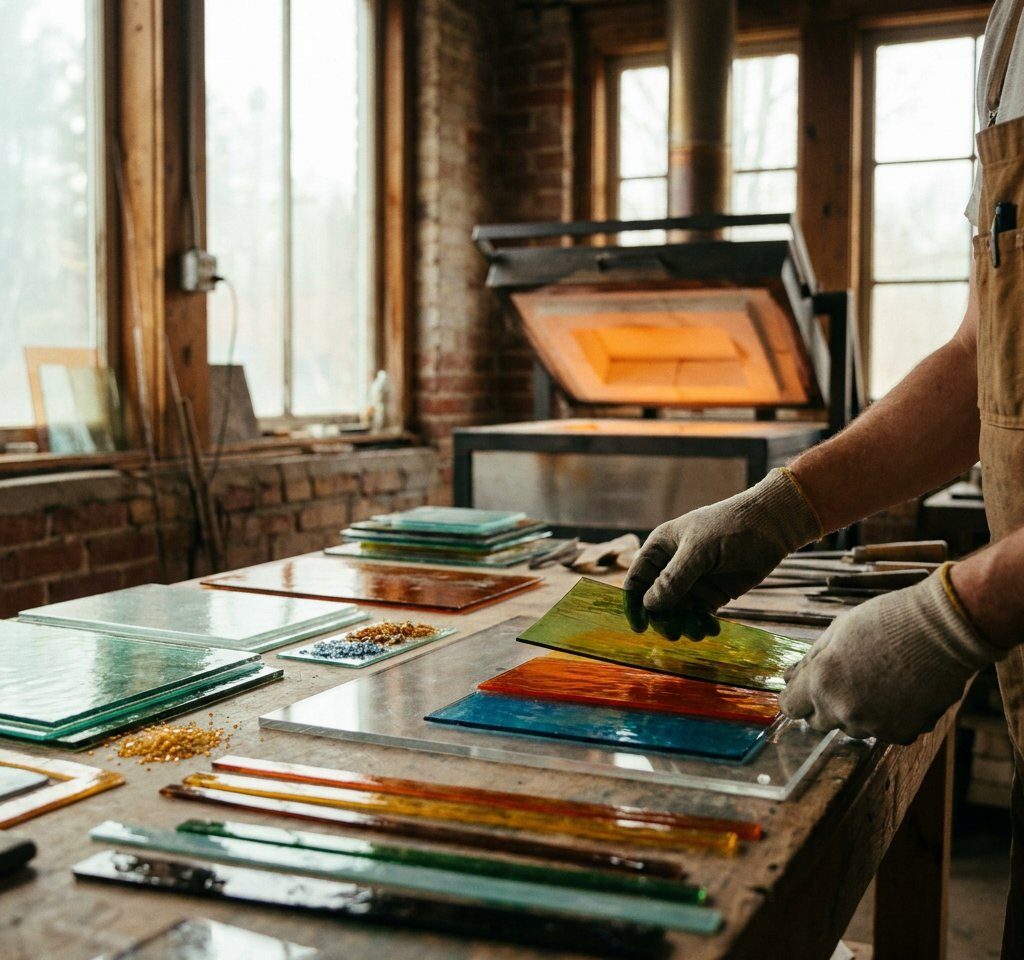
What is glass fusing? Explanation of technique and applications
|
Glass fusing is a technique in which separate pieces of glass are fused together in a kiln to form one new object. Think of sheets, strips, granules or powders of glass that together create a pattern, color gradient or relief. The result can remain flat, but it can also later be formed in a mold into, for example, a bowl, panel or other art object. It is precisely this combination of color, light and form that makes glass fusing so popular within glass art.
If you are wondering exactly what glass fusing is, it is best seen as controlled melting of glass with heat. The technique requires the right glass types, a carefully programmed firing schedule and knowledge of temperature and cooling. In this guide you will read how glass fusing works, which steps are involved and why the technique offers so many possibilities for decorative glass art.
How does glass fusing work?
In glass fusing, different pieces of glass are placed on or next to each other according to a design. The glass then goes into a special kiln, where it is slowly heated to a temperature at which the pieces fuse together. How far that fusion goes depends on the peak temperature, the duration of the firing and the type of glass you use.
The process often starts with cold-working: cutting, breaking, grinding glass, or working with glass frit and glass powder. Everything is then built up in layers. During firing the glass softens and flows together. After the peak temperature the glass must cool in a controlled way. This is important to prevent stress and cracks.
The end result can be crisp and graphic, but also organic and flowing. This means the technique suits many styles; see also Types of glass art and techniques.
What happens in the kiln?
The kiln is the heart of glass fusing. During the firing process the glass is not heated suddenly, but warmed step by step. That prevents excessive stress in the material. Depending on the desired effect the glass is often heated to roughly 700°C to 800°C or a little higher. At lower temperatures shapes and edges remain more defined, while at higher temperatures the glass levels out more and becomes smoother.
After heating comes a crucial stage: controlled cooling. Glass seems sturdy, but it is sensitive to stress if the temperature drops too quickly. That’s why glass fusing involves not only melting, but also careful annealing—letting the glass cool without internal stress. This process can take hours, sometimes longer, depending on the thickness and size of the piece.
Because temperature has such a big influence on the outcome, glass fusing is a technique where precision and creativity meet.
Which temperatures are used in glass fusing?
There isn’t one fixed temperature that always applies, because the desired result determines a lot. Still, there are general guidelines that help you understand how glass behaves in the kiln.
- Around 650°C to 700°C – the glass begins to soften and can be suitable for bending or light deformation.
- Around 750°C to 800°C – glass pieces clearly fuse together; commonly used for standard fusing.
- Above 800°C – the glass flows out further and shapes become rounder and smoother.
- On a second firing – the glass can slump into a mold to become a plate, bowl or wavy form.
The exact settings always depend on the glass type, thickness, kiln and the intended design. That’s why temperature in glass fusing isn’t a side detail, but one of the most important aspects of the technique.
Which kiln for glass fusing?
People who search for which kiln is needed for glass fusing usually mean a dedicated glass kiln or fusing kiln. Such a kiln must be precisely controllable and suitable for controlled heating and cooling. A regular household oven is not suitable for this.
A kiln for glass fusing usually has a programmable controller, so different temperature steps can be set. This is necessary because glass must be brought up to peak temperature slowly and then cooled in a controlled way. The size of the kiln also determines how large the workpiece can be.
- Small kiln – suitable for decorative pieces, test tiles and small bowls
- Medium kiln – useful for panels, decorative objects and small series
- Large kiln – suitable for larger glass panels or more spacious art objects
It’s not only the size that matters. Even heat distribution and reliable temperature control are also important if you want a good, stress-free result.
Which materials do you use in glass fusing?
Glass fusing is not only about heat, but also about choosing the right materials. You usually work with specially made fusible glass that is matched for thermal expansion. That’s important, because different glass types react differently to heat and cooling. If they don’t match, the glass can later crack or break.
Common materials in glass fusing are:
- Glass sheets – for the base layer and larger areas
- Glass strips and glass pieces – for lines, patterns and construction
- Frit – crushed glass in different grain sizes
- Glass powder – for subtle color fields and soft transitions
- Molds – to let glass slump into shape after fusing
Sometimes decorative accents are added between layers of glass, as long as they are suitable for the technique and can withstand the temperatures. This results in many variations in color, texture and depth.
What is the difference between glass fusing and slumping?
Glass fusing and slumping are often mentioned together, but they are not exactly the same. Glass fusing is mainly about fusing separate glass pieces into one whole. In slumping, an already fused or formed glass object is reheated so it can sink into or over a mold.
Practically, this often looks like this:
- First firing – glass pieces are fused into a flat sheet or composition
- Second firing – the object gets a curved or three-dimensional shape with the help of a mold
In this way, a flat design can later become a bowl, dish, wall piece or decorative form. This combination makes the technique extra versatile within glass art.
What can you make with glass fusing?
Glass fusing is used for many decorative and artistic objects. Because color, transparency and form can be combined so freely, the technique fits well with contemporary glass art and interior decoration.
- Bowls and dishes
- Wall panels
- Abstract glass art
- Decorative flowers or organic forms
- Vases and sculptural objects
- Small decorative pieces and accents for the interior
At Eliassen you’ll mostly see glass fusing as a technique within the broader world of glass art. If you’re looking for inspiration for glass art at home or at the office, you can view the Glass art collection online or visit the showroom in Ammerzoden. There you’ll find not only glass art but also paintings, bronze sculptures and other decorative art objects, with personal service and quality at a competitive price. Already have glass art at home? Then take a look at our tips for Maintaining and cleaning glass art.
Why is glass fusing popular within glass art?
The appeal of glass fusing lies in the mix of craftsmanship and surprise. You design in advance with color, form and layers, but only after firing do you see the final interplay of transparency, depth and light. No object looks completely flat or lifeless, because glass always reacts differently to the light. Read more about The importance of light in glass art.
Glass fusing also offers a lot of freedom. You can work with clean lines, soft color gradients, or relief and texture. This means the technique suits different styles, from subtle interior art to striking eye-catchers. For enthusiasts wondering What is glass art?, that’s what makes glass fusing so interesting.
What should you pay attention to when fusing glass?
Anyone who wants to understand what it technically means to fuse glass should also know where the risks lie. The most important points of attention are material compatibility, temperature control and cooling.
- Use glass that matches in coefficient of expansion (COE)
- Work with a kiln that is accurately programmable
- Avoid cooling too quickly to limit stress
- Consider the effect of temperature on shape and detail
- Use suitable molds and kiln materials for subsequent firings
It’s precisely this technical side that makes glass fusing more than just decorative work with glass. It’s a field in which knowledge of material behavior is essential for a beautiful and durable result.
Frequently asked questions about glass fusing
What is glass fusing in brief?
Glass fusing is the fusing together of separate pieces of glass in a special kiln. With heat, the pieces form one new object, such as a bowl, panel or artwork.
What is ‘glas fusing’?
‘Glas fusing’ is the Dutch spelling often used for the same process as glass fusing. Both terms refer to fusing glass using high temperatures.
How does glass fusing work step by step?
It usually starts with cutting glass or laying it out in a design. Then it is fired in the kiln so the glass fuses. After that it cools in a controlled way. Sometimes the piece is given a second firing to form it in a mold.
Which kiln do you need for glass fusing?
You need a dedicated fusing kiln or glass kiln with a programmable temperature controller. That allows you to heat and cool the glass safely and in a controlled way.
At what temperature does glass melt in glass fusing?
That depends on the desired effect, but glass fusing often happens somewhere between about 700°C and 800°C or a bit higher. Higher temperatures usually give a smoother and more fully fused result.
Can you combine different types of glass?
That’s only wise if the glass types are technically compatible. Glass with different expansion values can cause stress and cracking later on.
Is glass fusing the same as glassblowing?
No, they are different techniques. In glassblowing you work with hot, molten glass that is formed directly. In glass fusing you first lay glass in a composition and then fuse it in the kiln.
What can you make with glass fusing for your interior?
Think bowls, vases, wall panels, abstract objects and other glass art that adds color, light and form to a space. If you’re looking for such glass art, you can find inspiration online or visit the Eliassen showroom in Ammerzoden.
Share on:
Share Tweet Share Share Pin it