



Artificial plant wall or hedge – inspiration and advice
|
An artificial plant wall or artificial hedge is a smart way to quickly add more greenery, atmosphere and privacy without the maintenance of real plants. Whether you want to refresh a bare wall, green up a balcony or make a commercial space feel warmer, artificial greenery instantly creates a fuller and well-kept look. Looking mainly for inspiration, want to know what to pay attention to in materials and installation, or unsure between loose artificial plants and a green wall? Here you’ll find the key information clearly organized.
At Eliassen you’ll find a proven wide range of artificial plants for indoors and sheltered outdoors, from small eye-catchers to large artificial trees. A complete artificial plant wall or hedge as a separate product category or mounting system is, based on the current site information, not explicitly listed. That’s why this page focuses on honest, practical information, helping you decide which solution suits your space, style and wishes. View our range of artificial plants.
What’s the difference between an artificial plant wall and an artificial hedge?
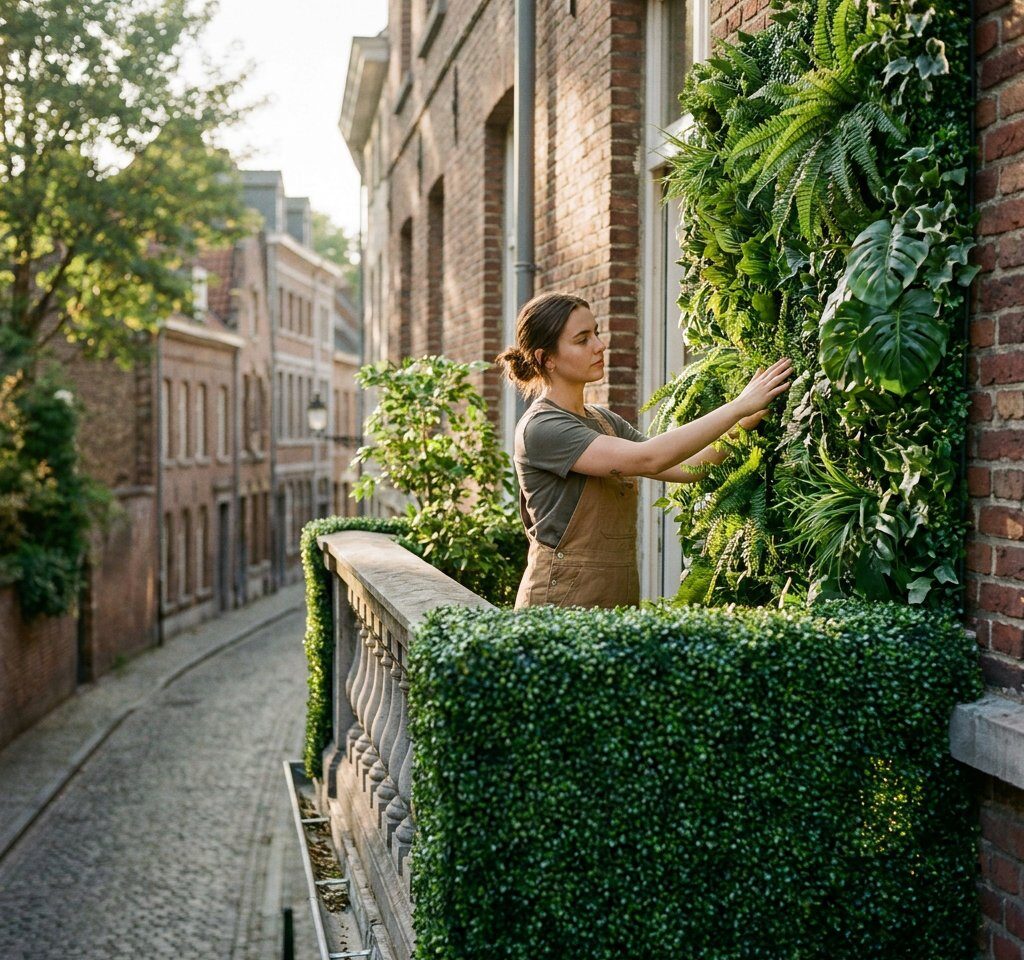
The terms are often used interchangeably, but there is a difference in application and look. An artificial plant wall is usually intended as a decorative green wall for indoors or sheltered outdoors. Think of a vertical wall with different leaf shapes, textures and heights for a luxurious, lively effect. An artificial hedge is more often chosen as a green partition or to cover a surface, such as a fence, balcony edge or garden screen.
In practice, you choose an artificial plant wall mainly for atmosphere and wall decoration, while an artificial hedge is more about privacy, finishing and a more streamlined green look. Neither solution is necessarily better. It’s mainly about your goal for the space.
- Artificial plant wall – decorative, playful, often more depth and variation
- Artificial hedge – screening, a denser closed look, often practical for privacy
- Both – low maintenance, instant green effect and suitable for many applications
Why choose artificial greenery on the wall or as screening?
The biggest reason is convenience. You get the green look without the work that normally comes with live plants. No watering, no pruning, no dieback due to lack of light and no seasonal changes that make a wall look less attractive. Especially in spaces with little daylight or where maintenance is difficult, artificial greenery is a practical choice.
A green wall also has a strong visual impact. A bare wall can feel hard and flat, while an artificial plant wall adds more texture, depth and softness. With an artificial hedge, functionality matters alongside appearance. You can easily hide a less attractive surface from view or make a place feel cosier and more sheltered.
Many people choose artificial greenery because it delivers instant results. You don’t have to wait for plants to fill out or recover. That makes it appealing for homes, offices, hospitality and retail where appearance matters right away.
Key benefits of an artificial plant wall or hedge
- Low maintenance – no water, pruning or plant food needed
- Always green – a full look all year round
- Versatile – suitable for homes, offices, hospitality and retail
- Instant atmosphere – a bare wall or dull partition looks warmer immediately
- Great for tricky spots – also useful where there’s little light
- Neater finish – ideal for upgrading a wall, fence or garden screen
- Flexible in style – from sleek and calm to jungle-like and eye-catching
What to look for in quality and materials?
Not every artificial plant wall or hedge looks equally realistic. The material and finish make a big difference. Good quality is often recognizable by variation in leaf color, visible veins, a matte finish and different leaf shapes. If everything has exactly the same gloss, color and height, it tends to look artificial more quickly.
For outdoors or sheltered outdoors, UV resistance is especially important. Without good protection, the greenery can discolor more quickly over time. Read our Guide to UV-resistant artificial plants for more background. Density also matters. Do you want privacy or a full wall? Then the construction needs to be compact enough so you don’t see too much of the surface behind.
Also check flexibility. Some panels or mats are easier to cut to size and better to fix over slight irregularities. That’s especially helpful when working on mesh, wood or an existing wall that isn’t perfectly flat.
| Aspect | What to look for | Why it matters |
|---|---|---|
| Leaf structure | Veins, variation in shape, layering | Creates a more natural effect |
| Color | Multiple green tones, not too uniform | Prevents a plastic look |
| Finish | Matte rather than highly glossy | Looks calmer and more realistic |
| Density | Sufficient fill between the leaves | Better for privacy and a fuller look |
| UV resistance | Important for outdoor use | Helps limit discoloration |
Applications of an artificial plant wall or hedge
The strength of this solution lies in its broad usability. You can use it decoratively, but also functionally. Depending on the spot, choose a calm green plane or a richly filled wall with more relief.
At home
In homes, an artificial plant wall often appears in the living room, hallway, home office or veranda. A green wall can give a bare wall more character, make a dining area cosier or soften a modern space. In an apartment or on a balcony, an artificial hedge is more often chosen as visual screening.
At the office or in commercial spaces
In offices, reception areas, shops and hospitality, artificial greenery helps make a space feel warmer and more inviting. Especially in interiors with a lot of glass, concrete or clean lines, greenery brings more balance. A green wall can also help visually zone areas, for instance between workstations or at an entrance.
Balcony, fence or railing
Outdoors, an artificial hedge is often chosen to finish a fence or balcony edge more neatly. It reduces the view of neighbors, the street or an unattractive background. That not only creates more privacy, but also a calmer overall look.
Decorative wall behind furniture or art
A green wall can also serve as a backdrop for other home decor. Think of a seating area, a side table or a striking artwork. Eliassen is known for its wide range of paintings, bronze statues and home accessories. So it makes sense to combine greenery with other mood elements, as long as the whole remains calm and balanced.
Use indoors or outdoors?
That depends on the material, the finish and the place you want to use it. Indoors you usually have more freedom in style and detail because the material is less exposed. For outdoors or sheltered outdoors, weather influences are much more important. Focus on UV resistance, fixings and how well the wall or hedge stays dense in the wind.
A spot under a canopy or on a sheltered balcony is usually more favorable than a fully exposed facade in sun and rain. Keep in mind that artificial greenery outdoors always requires more care than indoors, though still limited compared to live planting. Anyone wanting to dive deeper into Artificial plants and sunlight: how to prevent discoloration will find additional explanations there.
How to fasten an artificial hedge or plant wall
A frequently asked question is: how do you fasten an artificial hedge? The right method depends on the surface. On mesh or fencing, cable ties or binders are often used. On wood, you can usually fasten more easily with screws or other suitable fixings. For a flat wall, it’s important that the base is clean, dry and solid.
Always start with a clear measurement plan. Measure height and width, determine where seams will fall and check in advance whether you need to trim panels or mats. This prevents a crooked or uneven-looking end result.
Practical step-by-step guide
- Measure the surface accurately.
- Decide whether you want decoration, privacy or both.
- Check whether the material is suitable for indoors or outdoors.
- Lay out panels or mats first for a logical layout.
- Fix from top to bottom and keep everything straight.
- Neatly trim any excess material to size.
- After installation, check that the wall looks evenly filled everywhere.
Useful installation tips
- Fit panels together tightly to minimize gaps
- Conceal fixing points for a neater result
- Outdoors, use sturdier fixings than in a sheltered indoor space
- On balconies and fencing, pay extra attention to wind load
How do you maintain artificial greenery?
One of the biggest advantages is that maintenance is limited. Indoors, dusting is usually sufficient. Use a duster, soft cloth or dry microfiber cloth. If there’s more dirt, you can carefully clean the material with a slightly damp cloth.
Outdoors or sheltered outdoors, dirt can build up more quickly due to dust, rain or pollen. In that case, gently wipe the wall now and then or lightly rinse it. Preferably avoid aggressive cleaners or abrasive products as they can damage the finish.
Are there any downsides to artificial plants?
Yes, and it’s good to consider them honestly. The main one is that artificial greenery doesn’t live. You don’t get the growth, fragrance or care experience of live plants. There are also big quality differences. A cheap artificial hedge may look less realistic or be less well finished.
For outdoor use, long-term discoloration is a concern, especially if the material isn’t UV resistant or is fully exposed to the elements. A carelessly installed wall also won’t look as good. A green wall stands out, so a neat finish is important.
Doubting between real and artificial? Choose based on the space, light, desired maintenance and your goal. If you value convenience, a lasting green result and quick styling, artificial is often the practical choice.
Which style suits your space?
Not every green wall has to be busy or tropical. The style strongly determines how the space feels. A calm artificial hedge with a uniform leaf structure suits modern balconies, tidy garden partitions or minimalist interiors. An artificial plant wall with different leaf sizes and depth creates a more luxurious, botanical or playful effect.
- Calm and sleek – suitable for modern interiors and tidy screening
- Full and natural – ideal for a warm, green look
- Jungle look – more depth, contrast and striking leaves
- Businesslike and stylish – great for an entrance, office or reception area
Alternative to a complete artificial plant wall
Because Eliassen currently demonstrably offers a wide range of artificial plants, but not explicitly a complete artificial plant wall or hedge as a separate product category, a loose styling solution can also be interesting. With larger artificial plants, ornamental grasses and matching pots you can also create a lot of green ambience without building a full wall. If you want to choose hanging plants specifically, see our Buying guide for artificial hanging plants.
For example, consider a combination of a tall artificial plant in a beautiful pot, a group of lower plants for layering and a painting or bronze statue as an eye-catcher next to it. Especially in a living room, office or showroom, that can be a stylish alternative if you want greenery but not a fixed wall solution. Take a look at the Hanging plant in pot Hedera (105 cm) for a full, green look.
The advantage is flexibility. You can move, combine and restyle more easily. In the webshop and in the showroom in Ammerzoden you can also better assess which sizes, shapes and materials match your interior. That fits well with Eliassen’s service-oriented family business approach.
Frequently asked questions about artificial plant walls and hedges
Is an artificial plant wall suitable for indoors?
Yes, an artificial plant wall is especially popular indoors. You don’t need daylight and you can quickly add atmosphere to a bare wall, hallway, office or reception area.
Can an artificial hedge be used outdoors?
Yes, provided the material is suitable for outdoor or sheltered outdoor use. Pay particular attention to UV resistance and sturdy fixings, especially on balconies, fencing and exposed, windy spots. Also check out the tips in Best artificial plants for outdoors if you want to use artificial greenery outside.
How do you fasten an artificial hedge?
On mesh or fencing, cable ties or binders are commonly used. On wooden surfaces, you can usually use other fixings. Always make sure the surface is solid and work neatly from top to bottom.
What are the downsides of artificial plants?
They aren’t alive, so you don’t get the natural growth or experience of caring for plants. There are also big differences in quality. A good finish and realistic look make a big difference.
Which artificial plants look real?
Artificial plants with matte leaves, color variation, visible veins and different heights usually look the most realistic. A natural placement and a matching pot or base also help a lot.
Does an artificial plant wall affect acoustics?
A green wall can make a space feel softer and helps visually against hard, bare surfaces. The acoustic effect depends on construction, materials and the rest of the space. See it mainly as an atmospheric addition, not automatically as a full acoustic solution.
How do you clean an artificial plant wall?
Usually, dusting is enough. Use a dry cloth, duster or microfiber cloth. For more dirt, carefully use a slightly damp cloth. Avoid aggressive cleaners.
Is an artificial hedge useful for privacy?
Yes, especially if you choose a full and dense variant. You can green up a balcony, fence or garden screen while reducing sightlines.
What’s better: an artificial hedge or loose artificial plants?
It depends on your goal. If you want to cover or screen a surface, an artificial hedge makes more sense. If you want flexibility and easy restyling, loose artificial plants are often more convenient.
Where can you find inspiration or see products in real life?
At Eliassen you’re welcome in the webshop and in the large showroom in Ammerzoden. That’s especially useful if you prefer to see colors, sizes and combinations with other home decor in real life first.
Share on:
Share Tweet Share Share Pin it