



How does a water ornament work? Explanation and tips
|
A water ornament operates with a closed water circuit: a pump draws water from a reservoir, pushes it up through the ornament, and then the water flows back to the same supply. That is precisely what makes a water ornament so appealing for a garden, patio, or balcony. You don’t need a fixed water connection, only a good setup, sufficient water, and usually power for the pump. Whether you opt for a compact patio fountain or a larger garden water feature, the principle is almost always the same.
Want to know exactly how the technology works, which types of water storage there are, and what to consider for placement, pump selection, and maintenance? Below you can read, step by step, how a water ornament functions and which setup best suits your situation.
The basic operation of a water ornament
The operation of a water ornament is simpler than many people think. Basically, you need three components: a water supply, a pump, and the ornament itself. The pump sits in or near the water reservoir and pushes the water upward through a hose. At the top, or via an opening in the ornament, the water comes out. It then runs along the surface or through multiple outlets back into the reservoir.
That means the water is continuously reused. You therefore don’t need to connect the ornament permanently to a water line. You will need to top up occasionally, because some water always evaporates—especially on warm days or in a sunny spot. With a model that has lighting, you often also need an extra connection in addition to the pump.
Most pumps for a water ornament run on mains power. That’s why a safe outdoor socket is important. If you have a larger model or an ornament with multiple water outlets, you’ll usually also need a more powerful pump to let the water flow nicely.
Which components do you need?
- A water ornament or fountain
- A water reservoir, pond, or built-in water tank
- A pond pump or fountain pump
- A water hose to connect the pump and ornament
- Optionally a cover plate and grid for a buried reservoir
- Optionally a 3-way splitter for multiple outlets
- A grounded outdoor socket
- Optional LED lighting
You’ll find more explanation of the basic setup and the function of each part under the components of a water ornament.
How the water circulates in the system
The water circuit of a water ornament is closed. The pump draws water from the tub or pond and forces it upward through a hose. You then see the water flow, bubble, or fall, depending on the model. After that, the water returns to the catchment beneath the ornament. As long as there is enough water in the reservoir and the pump functions properly, this cycle continues.
This makes a water ornament more low-maintenance than many people expect. You’re not constantly consuming new water. It is important to keep an eye on the water level, though. If the pump gets too little water, it can run dry. You want to prevent that, because it shortens the pump’s lifespan.
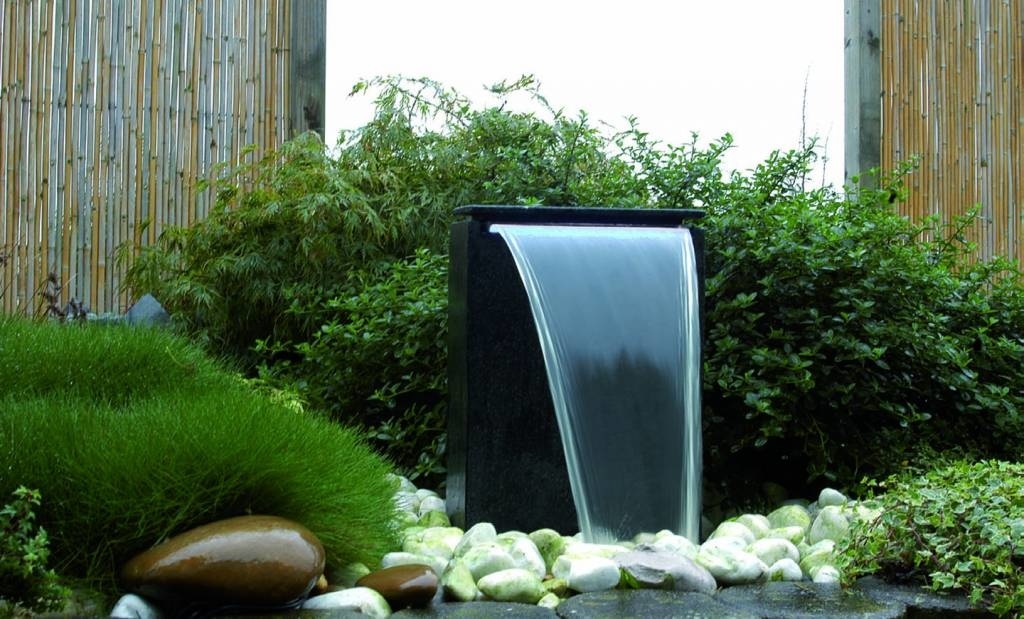
With water tables, circulation works via a crisp overflow edge; see examples of water tables (ADEZZ) to observe the overflow principle and flow rate in practice.
What types of water storage are there?
A water ornament always needs a water supply. Which solution is best depends on the location, the type of ornament, and how much space you have. In practice, you mainly see three systems.
Water ornament in or beside a pond
If you already have a pond in the garden, it can serve perfectly as the water supply. Place the pump in the pond and connect it to the water ornament with a hose. The water is pumped up and then flows back into the pond. This makes it a logical and relatively simple solution.
It is important that the ornament stands firmly. Especially with stone or bronze models, the surface must be stable. If the ornament stands partly in the pond, make sure there is a solid riser or support. There must also be enough room for the hose and the connection, without them getting pinched.
A pond setup is especially convenient if you already have water in the garden and want to create a natural whole between the pond and the ornament.
Water ornament with a buried reservoir
If you don’t have a pond, a buried water tank is usually the most popular solution. In this case you place a reservoir in the ground, directly under or right next to the ornament. The pump sits inside it. On top of the reservoir there is often a cover plate or grid so that everything remains neatly out of sight.
The big advantage is that you get the effect of flowing water without looking at an open basin. It gives the garden a clean and calm look. This setup is common with larger garden fountains and natural stone models.
The base must be flat and level. A layer of sand is often used to bed the reservoir firmly. Then you place the cover plate, the grid, and the ornament. The water that runs over the ornament passes through the grid back into the tank, after which the pump circulates it again.
In hot weather, a reservoir with sufficient volume is convenient, because you’ll need to top up less often. For larger installations, a float valve system can be useful to keep the water level automatically topped up.
A complete example of such a closed recirculation system can be found under our water feature with in-ground basin.
Above-ground water storage or patio fountain
A patio fountain is a water ornament with a built-in reservoir. The pump and water supply are then located at the bottom of the model itself. That means you don’t need excavation work and you can more easily place the ornament on a patio, balcony, or in a small courtyard. See practical plug-and-play examples with our patio fountains.
This type of water ornament is popular if you want to add ambiance quickly without installing a complete system in the garden. Compact models made of polyresin or lighter materials are easy to move. There are also heavier versions in granite, marble, or concrete for a more luxurious look.
An above-ground setup is practical, but you do need to watch the water level and frost in winter. Especially with stone models, it’s wise to empty the ornament in time or make it winter-ready according to the product instructions.
How do you choose the right pump for a water ornament?
The pump is the heart of the water ornament. Without a good pump, there is no beautiful water movement. The pump you need mainly depends on three factors: the height of the ornament, the number of outlets, and the desired water effect.
- Height of the ornament – the higher the water needs to go, the more pump power is required.
- Number of outlets – with multiple discharge points, the capacity must be divided.
- Type of water effect – a calm, laminar flow asks for something different than a clear waterfall or powerful jet.
For a small ornament, a lighter pump is often sufficient. For larger models or a water ornament with three outlets, you need more capacity to achieve a nicely even effect everywhere. If the pump is too weak, the water hardly reaches the top or doesn’t flow neatly over the ornament. If the pump is too strong, water can splash outside the catchment basin.
Why flow distribution matters
With ornaments that have multiple water columns or outlets, equal distribution of water is not automatic. Water chooses the path of least resistance. As a result, the lowest or easiest point can receive most of the water while another part barely flows.
A 3-way splitter is often the solution. It allows you to distribute the water over multiple hoses and adjust the flow per outlet. This creates a calmer and more attractive end result. With complete sets this is often well matched, but with separate components it’s smart to pay extra attention to this.
What should you consider when placing?
Placing a water ornament isn’t just about appearance, but also about ease of use and durability. A good location prevents malfunctions, unnecessary maintenance, and water loss.
Choose a stable, level base
An ornament must stand firmly. If it’s tilted, the water won’t return neatly to the reservoir and you may get leaks or splash loss. A stable base is essential, especially for heavy ornaments made of concrete, granite, or marble.
Consider sun and wind
Full sun increases evaporation and can accelerate algae growth. In a sheltered spot you’ll have less trouble with water being blown away, especially with models that have falling or splashing water. A protected location is therefore often more practical than an open, windy corner.
Ensure power nearby
You almost always need electricity for the pump. Preferably use a safe outdoor socket near the ornament. An extension cord across the patio or garden looks less tidy and is usually less desirable. If the model has lighting, two connection points are often needed.
Install a water ornament step by step
Want to know how installing a water ornament works in practice? These are the main steps of a common setup with a buried reservoir.
- Determine the location and check that the base is stable.
- Dig the hole for the reservoir and make the bottom flat.
- If necessary, add a sand bed and set the tank level.
- Place the pump in the reservoir and connect the hose.
- Position the cover plate or grid.
- Place the ornament correctly above the opening or on the cover plate.
- For multiple outlets, connect a splitter.
- Fill the reservoir with water.
- Start the pump and check that the water returns neatly.
- Adjust the flow until the desired effect is achieved.
If you buy a complete set, the pump, hose, and fittings are usually well matched. If you’re choosing components for water ornaments, pay extra attention to the ornament’s size, the reservoir’s holding capacity, and the pump power.
Maintenance of a water ornament
A water ornament is generally low-maintenance, but not completely maintenance-free. Because of evaporation, you’ll need to top up water regularly. In addition, dirt, leaves, and algae can affect water quality and the pump’s performance.
- Regularly check the water level
- Clean the pump if it seems to be losing power
- Remove leaves and debris from the reservoir
- Refresh the water when it turns green or cloudy
- If you want to limit algae, only use products suitable for ornaments
In summer you’ll need to top up more often. In autumn it’s wise to pay extra attention to falling leaves. This keeps circulation working well and prevents the pump from clogging. As winter approaches, frost protection is important; that’s how you can winterize your water ornament.
Which materials are common for water ornaments?
The material determines not only the appearance, but also maintenance, weight, and suitability for a particular location.
| Material | Characteristics | Point to note |
|---|---|---|
| Concrete | Solid, robust look and popular in gardens | Heavy, so it requires a stable base |
| Granite | Durable, luxurious appearance, and relatively low-maintenance | Solid and heavy to place |
| Marble | Chic and decorative | Pay attention to maintenance and placement |
| Polyresin | Lighter in weight and often suitable for patio or balcony | Be mindful of winter protection |
| Bronze | Exclusive look and very suitable as a statue with a water function | Often higher-end and a heavier model |
At Eliassen you’ll find water ornaments in various materials and styles, from compact patio models to larger eye-catchers for the garden. Personal advice is helpful, especially if you’re unsure about the right setup or pump combination.
Can you have a water feature without electricity?
In most cases, no. A classic water ornament needs a pump to circulate the water, and that pump usually runs on electricity. Without power, you won’t have continuous water movement. There are solar-powered solutions, but they are highly dependent on sunlight and don’t always deliver a consistent result. If you want reliably flowing water, an electric pump is usually the best choice.
Is a water ornament a good idea?
For many gardens and patios, yes. A water ornament brings movement, sound, and atmosphere to your outdoor space without the need to install a full pond. Especially if you have limited space, a fountain or an indoor fountain is a smart way to add water to your garden design. In addition, there are many models available, from sleek and modern to classic or with the appearance of a bronze statue.
If you’d like to view different models in real life, that’s often a big advantage. In addition to the webshop, Eliassen has a large store and showroom in Ammerzoden where you can view many water ornaments, statues, and garden objects. That makes it easier to compare size, material, and water effect.
Frequently asked questions about how a water ornament works
Does a water ornament always need a pump?
Yes, a pump is needed for continuous water circulation. The pump ensures the water is lifted and can flow back to the reservoir.
Does a water ornament need to be connected to the water mains?
No, usually not. The water circulates in a closed system. You only need to top up occasionally to compensate for evaporation or splash loss.
How often do you need to top up water?
That depends on the weather, the location, and the type of ornament. In warm weather and full sun, water evaporates faster, so you’ll need to check more often.
What if water doesn’t come out of all openings nicely?
The pump may not be powerful enough or the distribution may not be adjusted correctly. With multiple outlets, a 3-way splitter helps regulate the flow better.
Can a water ornament be placed on a patio?
Yes, patio fountains are ideal for that. They often have a built-in reservoir, so there’s no need to dig a pit.
Why does the water turn green?
Green water is usually caused by algae, especially in warmth and sunlight. Refreshing regularly, cleaning, and choosing a suitable location helps limit this.
Which is better: a complete set or separate components?
A complete set is often simpler because the pump, hoses, and ornament are matched. Separate components give you more freedom but require more attention to compatibility.
Can I leave a water ornament outside in winter?
That depends on the material and construction. Many models must at least be emptied or made winter-ready to prevent frost damage. Always check the product specifications.
If you want to buy a water ornament that suits your garden or patio, it helps to consider the desired look, available space, and installation method in advance. Also read the buying guide: what to look for in a water ornament. With the right combination of ornament, reservoir, and pump, you’ll enjoy a water feature that not only looks beautiful but also works well technically. At Eliassen you can explore online or visit the showroom in Ammerzoden for personal advice, service, and a wide selection for customers throughout the Netherlands and Belgium.

Share on:
Share Tweet Share Share Pin it